
What Is DOCCS?
DOCCS is the official abbreviation used by the New York State Department of Corrections and Community Supervision. It runs the state prison system and community supervision functions after release. County jails and NYC DOC jails handle local custody, including many recent arrests and pretrial holds. DOCCS becomes the main lookup path when a person has entered state-prison custody after sentencing, reception, and classification.
The agency site groups public functions that matter for inmate search: incarcerated look-up, parolee look-up, facilities, Board of Parole, community supervision, research, reports, FOIL, PREA, and Office of Special Investigations. That makes DOCCS the statewide source for the sentenced prison side of the New York inmate population.
The DOCCS incarcerated lookup landing page is the official route into the state-prison locator.
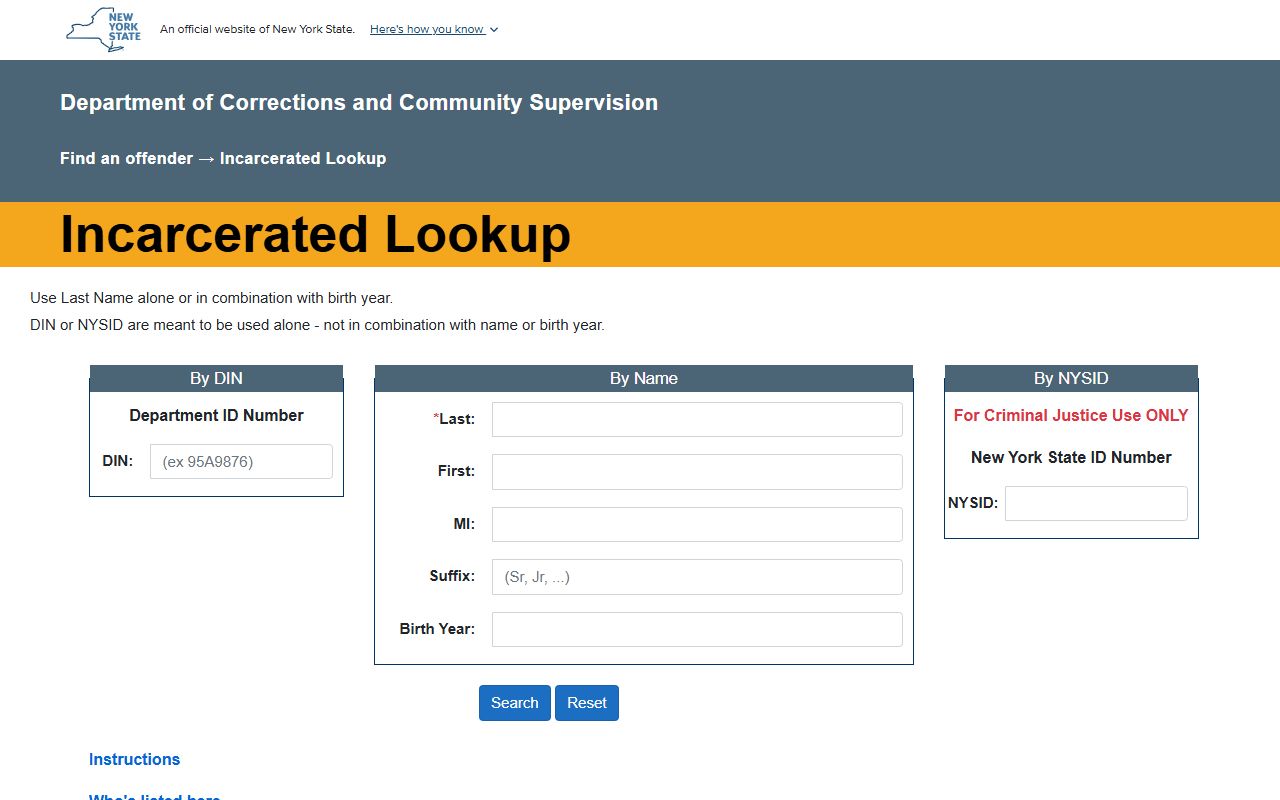
The landing page is useful because it separates the lookup from other agency functions such as parole, facilities, and records requests.
The DOCCS Inmate Population
The researched DOCCS Fact Sheet July 2026 reports 34,066 incarcerated individuals in 41 DOCCS facilities as of July 1, 2026. It also reports 17,513 active releasees in New York State and 24,446 parolees under DOCCS responsibility. Those parole and release figures can matter to families, but they are not the same as the incarcerated DOCCS inmate population.
| Measure | Figure | Source Date |
|---|---|---|
| DOCCS inmate population in custody | 34,066 | July 1, 2026 fact sheet |
| DOCCS facilities | 41 | July 2026 fact sheet and facility directory |
| Active releasees in New York State | 17,513 | July 2026 fact sheet |
| Total parolees under DOCCS responsibility | 24,446 | July 2026 fact sheet |
How to Search DOCCS
The DOCCS inmate locator searches people incarcerated in New York State DOCCS facilities and formerly incarcerated people whose records remain public under lookup rules. The lookup is generally available 24 hours a day, except for brief nightly maintenance and a longer Saturday night maintenance window described in DOCCS instructions.
- Open the direct DOCCS lookup application.
- Search by DIN first if the Department Identification Number is known.
- Search by exact last name and birth year when the DIN is not known.
- Try partial last-name searching for spelling variants, hyphenation, or alias issues.
- Verify the DIN, facility, current or former status, and sentence or release fields before relying on the match.
The direct DOCCS lookup application is the screen used after the searcher has decided state-prison custody is the right system.
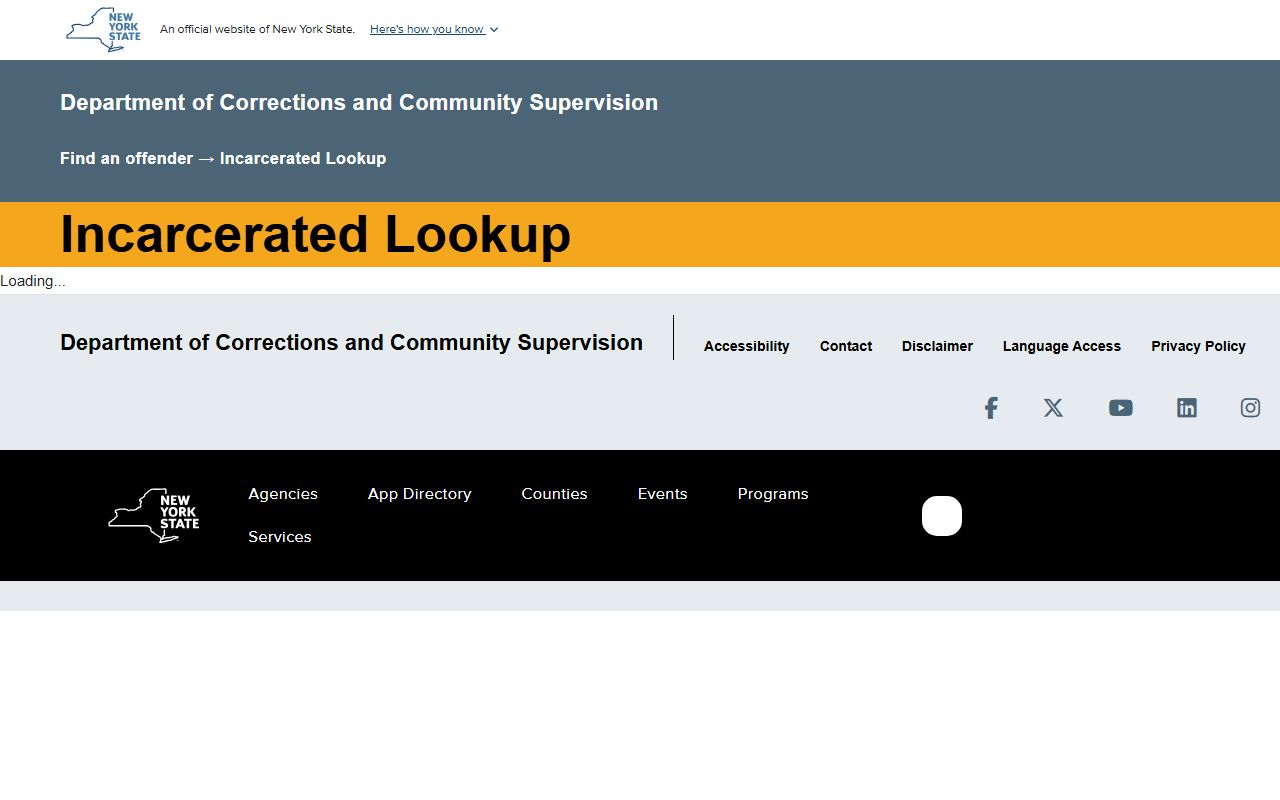
DIN searching is the cleanest path because a name-only search can return many people or miss spelling variants.
DOCCS Inmate Locator Fields
DOCCS instructions define the main search fields. A DIN is assigned when a person is admitted to DOCCS and follows that term of commitment. NYSID is a criminal justice identifier that the public lookup will accept if already known, but the lookup does not display the NYSID. Name searches depend on last-name spelling and birth-year clues.
| Field | How It Works | Practical Limit |
|---|---|---|
| DIN | Assigned by DOCCS at admission | Best search, but must be known first |
| NYSID | Accepted if the searcher already has it | Not displayed by DOCCS lookup |
| Last name plus birth year | Narrows exact last-name matches | Misspelling can hide the record |
| Partial last name | Returns names beginning with the entered text | Can require manual review |
The DOCCS lookup instructions explain these search paths and the public-record limits in plain language.
Those instructions also explain why youthful-offender, sealed, reversed, and Correction Law Section 9 records may not appear online.
DOCCS Prisons and Facilities
The official DOCCS facility directory reported 41 results when researched. It filters by county, gender, and maximum, medium, or minimum security. Individual facility pages list addresses, main lines, superintendent names, gender served, security level, visitation notices, programs, and PREA audit links. The active list includes maximum-security, medium-security, minimum-security, shock/program, residential treatment, and special-mission facilities.
Maximum-security facilities include major prisons such as Attica, Auburn, Bedford Hills, Clinton, Coxsackie, Eastern NY, Elmira, Five Points, Green Haven, Shawangunk, Sing Sing, Upstate, and Wende. Medium-security facilities make up the largest group. Minimum-security and special-purpose facilities include Edgecombe Residential Treatment Facility, Lakeview Shock Incarceration Correctional Facility, and Queensboro Correctional Facility.
The DOCCS facilities directory is the active source for current prison listings and filters.
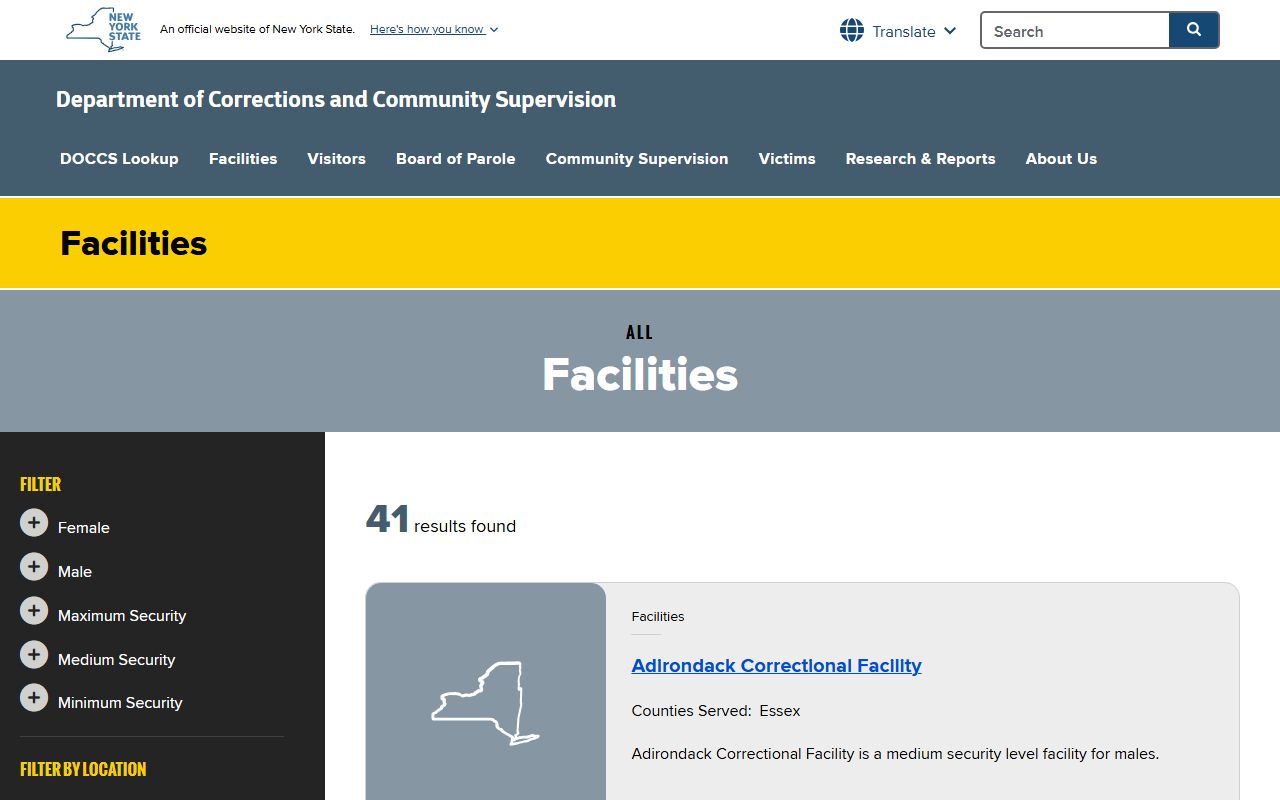
The statewide facility directory combines those DOCCS rows with county jails, NYC DOC commands, federal facilities, and ICE detention.
DOCCS Inmate Population Trends
New York's prison system is much smaller than it was at the 1999 high point. DOCCS reports a decline from 72,649 incarcerated individuals in 1999 to 34,066 on July 1, 2026, a 53.1 percent decrease. Since 2011, the state closed 27 correctional facilities because of excess bed capacity and staffing shortages. Recent counts show a modest rebound from the 2021 low.
| Year | DOCCS Count | Note |
|---|---|---|
| 1999 | 72,649 | High point cited by DOCCS |
| 2021 | 30,746 | Recent low in extracted table |
| 2022 | 31,329 | End of year |
| 2023 | 32,766 | End of year |
| 2024 | 33,677 | End of year |
| 2025 | 33,845 | End of year |
| July 1, 2026 | 34,066 | DOCCS Fact Sheet July 2026 |
DOCCS Sentence and Release
DOCCS sentence and release data should be treated as official custody information, not legal advice. The Community Supervision Handbook says the Inmate Records Coordinator at each correctional facility calculates sentence time after reception, including jail-time credit, earliest release dates, conditional release dates when applicable, and maximum expiration dates. If jail-time credit is disputed, DOCCS directs the person to work through the IRC and, when needed, the sentencing court or local jail.
- Indeterminate sentence
- The court sets a minimum and maximum term, and parole-board release can occur after the minimum.
- Determinate sentence
- The court sets a fixed prison term and usually a post-release supervision term.
- Conditional release
- A statutory release path tied to good time and written agreement to supervision conditions.
- Maximum expiration
- The point when the court-imposed maximum sentence ends and the person is discharged.
Online dates can change when jail credit, good time, disciplinary decisions, warrants, revocations, appeals, or new sentences change the calculation.
DOCCS vs County Jail
The DOCCS inmate population is the state-prison population. County jail rosters cover local custody. That distinction is the most common search error in New York inmate lookup. A person can be arrested, booked into a county jail, appear in court, receive a state sentence, and later transfer into DOCCS. The correct record changes as custody changes.
| Question | DOCCS | County or NYC Jail |
|---|---|---|
| Who is held? | Sentenced state prisoners | Pretrial, local sentence, holds, state-ready, and other local categories |
| Who runs it? | New York State Department of Corrections and Community Supervision | County sheriff, county correction department, or NYC DOC |
| Where to search? | DOCCS incarcerated lookup | County roster or NYC DOC custody lookup via the locality directory |
DOCCS Records Requests
DOCCS records requests run through New York FOIL. The DOCCS FOIL page accepts online requests and written requests by mail, email, or fax. The researched mailing address is Records Access Officer, Department of Corrections and Community Supervision, Harriman State Campus, 1220 Washington Avenue, Albany, NY 12226-2050. The researched fax number is 518-453-8474. Inspection is by appointment at the same campus.
DOCCS says requesters should reasonably describe the records and include dates, names, locations, and DIN or NYSID when possible. It responds within five business days by providing records, denying the request in writing, or acknowledging receipt. Appeals must be made within 30 days of a written denial and go to the Records Appeal Officer. DOCCS says medical-record requests and criminal-history/RAP sheet requests use different processes.
Do Not Mix DOCCS Counts
The DOCCS inmate population should not be blended with county jail average daily census, NYC DOC census figures, federal BOP custody, or ICE detention. Each system uses its own legal custodian and reporting cycle. DOCCS counts people in state prison. SCOC and DCJS reports count local jail categories such as unsentenced detainees, sentenced local jail inmates, parole violator holds, state-ready people awaiting transfer, federal board-ins, and other local custody groups.
This distinction matters for records too. A county jail can hold a person before trial, after a local sentence, on a technical parole hold, or while waiting for transfer. DOCCS becomes the record source after state reception and classification. A person can therefore appear in one system, move, and later appear in another. The search should follow custody, not the county where the case began.
DOCCS Inmate Population FAQ
How big is the DOCCS inmate population?
DOCCS reported 34,066 incarcerated individuals in 41 facilities as of July 1, 2026. That figure is for state-prison custody, not local jail ADP, federal custody, ICE detention, or VINE notification records.
Why does a DOCCS search show no result?
The person may be in a county jail, NYC DOC custody, federal custody, or ICE detention instead of DOCCS. A no-result search can also reflect youthful-offender confidentiality, sealed or reversed convictions, spelling problems, or Correction Law Section 9 internet-removal limits.
Can DOCCS confirm a county jail inmate?
No. DOCCS is the state prison and community supervision agency. County jails, NYC DOC, BOP, and ICE have their own lookup systems.
Does the DOCCS inmate population include parolees?
The in-custody DOCCS inmate population is different from parole and community supervision. The July 2026 research reports 34,066 incarcerated individuals, 17,513 active releasees in New York State, and 24,446 parolees under DOCCS responsibility. Those release figures are important, but they should not be counted as people held in prison.
Why can a DOCCS release date change?
Release dates can change when jail-time credit, good time, disciplinary decisions, revocations, warrants, appeals, new sentences, or sentence-calculation corrections change the record. DOCCS instructions and facility records staff are stronger sources than copied third-party dates.
Public Record Search
Sponsored Results